
These online assessment ideas focus on selected required knowledge from the SS6 Reduce sustainability risk Skill Set. These assessment ideas do not cover all the assessment requirements for the Skill Set.
UPDATE: These resources have not been designed or mapped to the updated units in the MSS Sustainability Training Package. However they do cover some of the key aspects of the MSS units of competency.
The following abbreviations have been used to show where the requirements are in the Skill Set units:
- E – Element
- PC – Performance Criteria
- RK – Required Knowledge
- RS – Required Skills
Ecological, social and economic sustainability issues
This is a requirement on MSS017001A (E1, E2, RK, Range)
Guidance
The Skill Set requires the learner to determine and analyse social, economic and environmental interactions and impacts of the organisation in order to determine the risk areas in sustainability.
The division of sustainability into the three areas is part of the principles of sustainability and is known as the triple bottom line or people, profit, planet.
Sample question
The question is presented as matching items. The learner is given a list of statements and has to match each one to the correct area of sustainability.
Online this could be a “drag and drop” function where only a correct answer will stay in place and allow the learner to move on to the next item.
Aspect of sustainability
- Social
- Economic
- Environmental
Statement from a business
- We wanted to be good corporate citizens and do the right thing.
- Some of the best solutions came from suggestions from staff. You might not tie a 3kW saving to an idea as simple as keeping the tools nearby and making each cabinet 30 seconds faster.
- I think certainly energy costs have increased over the last few years and we had to look at our cost base and we saw opportunities.
- In the manufacturing team we look at ourselves as a profit centre. We ask how efficient is our whole process of getting the product out the door at the lowest cost?
- It was certainly very important to us to reduce our overall carbon footprint given the effects of greenhouse gases on the climate.
- We introduced a Lean manufacturing programme and part of that identifies and reduces waste in the whole of operation, which saves us money.
Correct answers
- We wanted to be good corporate citizens and do the right thing – Social
- Some of the best solutions came from suggestions from staff. You might not tie a 3kW saving to an idea as simple as keeping the tools nearby and making each cabinet 30 seconds faster – Economic
- I think certainly energy costs have increased over the last few years and we had to look at our cost base and we saw opportunities – Economic
- In the manufacturing team we look at ourselves as a profit center. We ask how efficient is our whole process of getting the product out the door at the lowest cost? – Economic
- It was certainly very important to us to reduce our overall carbon footprint given the effects of greenhouse gases on the climate – Environmental
- We introduced a Lean manufacturing program and part of that identifies and reduces waste in the whole of operation, which saves us money – Economic
Sustainability impacts
This is a requirement in MSS017001A (E2, RK)
Guidance
The Skill Set requires the learner to determine the significance of the sustainability impacts so that they can rank them by significance before developing responses to the significant impacts.
The factors that lead to an impact being significant or not will differ from organisation to organisation and may include factors such as environmental sensitivity, reducing costs, company reputation, community sensitivity, regulations, risk of permanent loss or degradation, meeting company goals and strategic plans and the speed of loss or degradation.
Sample question
This question is presented as multiple choice. In an online assessment the learner typically sees an explanation if they select a wrong answer. In a formative assessment they might be allowed to keep trying until they get it right. In a summative assessment only the first answer is likely to be accepted and “marked”.
“With solar and all the other savings we could reduce our electricity purchases by 2,500 kW per day, and that would be carbon neutral which is what we are aiming for.”
Which one of the following factors makes the sustainability impact of electricity use significant in the above quote?
A Environmental sensitivity
Not correct. There is no information provided that suggests that environmental sensitivity is a factor giving electricity use a significant sustainability impact.
B Reducing costs
Not correct. There is no information provided that suggests that reducing costs is a factor giving electricity use a significant sustainability impact.
D Meeting company goals
Correct. The company goal is to become carbon neutral and reducing electricity use will have a significant impact on achieving this goal.
E Meeting regulations
Not correct. There is no information provided that suggests that meeting regulations is a factor making electricity use a significant sustainability impact.
Analysing energy use using a causal tree
This a requirement of MSS017001A (PC 3.1, RS, RK)
Guidance
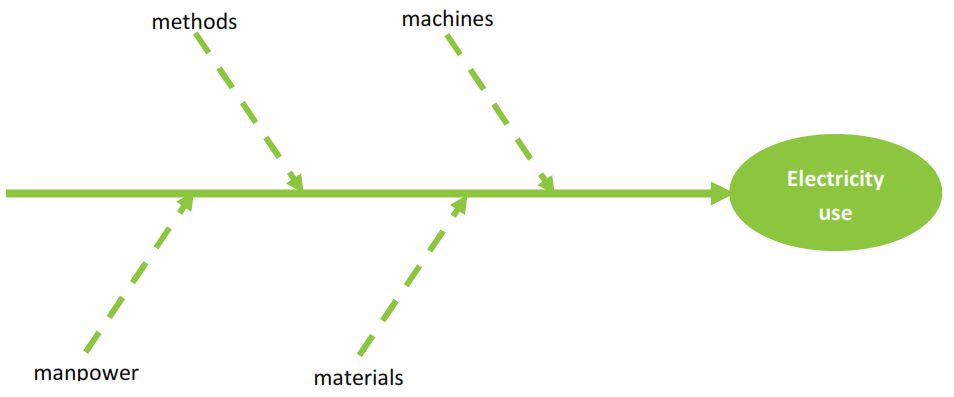
The Skill Set requires the learner to analyse the causal tree for each significant sustainability impact. Analysis of the causes will lead to developing an appropriate response for each interaction.
Sample question
This question is presented as label and image. The learner is given a list of causal ideas that relate to the ‘spines’ of a fishbone diagram.
Online this could be dropping labels onto he correct ‘spine’ of an image selecting where only the correct answer will stay in place.
 Spine – methods
Causal ideas for method:
- The air conditioning in the office is on, even when the sales team are all out on the road
- The design of the product requires lots of separate processes that each requires the use of power
- The lighting switches are set up so that all the lights have to be on at once
Spine – machines
Causal ideas for machines:
- The compressor is running at full capacity all the time when it could run on variable speed
- The compressors leak air so the motors have to work harder
- The compressors are used to blow away dust when a vacuum would do the job better
Spine – manpower
Causal ideas for manpower:
- The workers in the factory leave the lights on all the time
- The workers turn all the machinery on at once at the start of the shift even though not all of it is used
Spine – materials
Causal ideas for materials:
- The raw materials we use are cheaper, but they require more power to be used during manufacture than alternative raw materials
- The raw material has a lot of embodied energy which is lost as offcuts and waste
