

The MSS Sustainability Training Package is now released on training.gov.au. This is the first release of the ‘streamlined’ units of competency and qualifications which have been updated to meet the requirements of the Standards for Training Packages.
There are a number of changes in the new MSS Sustainability Training Package. Some of the changes will have a significant impact for Registered Training Organisations, their Training and Assessment Strategies and assessment materials.
What is new in the ‘new’ units?
Unit template changes
The main focus of this compliance work was updating each unit of competency to meet the new template requirements. The changes to the sections are:
- omission of Unit descriptor
- inclusion of Foundation Skills
- omission of Employability Skills
- inclusion of Range of Conditions
- omission of Range Statements
- inclusion of the Assessment Requirements for each unit of competency
- omission of Required Skills, Required Knowledge and Evidence Guide.
While the new sections in the template sound similar to the previous ones they provide different information. And there are clearer definitions (tighter requirements) on the information conveyed in each section.
Assessment Requirements
The new template divides a unit of competency into two parts – ‘unit of competency’ and ‘assessment requirements’. This terminology is confusing and the two parts can be downloaded as separate files from training.gov.au. The rationale for this was that some people might want to refer to the ‘front’ part of the unit without needing to undertake an assessment. For example, enterprises might want to use the Elements and Performance Criteria as guidance or benchmarks for their procedures or workplace training.
However the two parts make up one complete unit of competency. And Registered Training Organisations must cover all of the requirements of the unit of competency (both parts) in order to assess and award the unit.
This Assessment Requirements define:
- Performance Evidence – an outline of the minimum evidence of performance needed in order to demonstrate competency. In the MSS Sustainability units of competency this is a summary of the type and amount of evidence needed in key areas of performance. RTOs need to define the methods for collecting the evidence and the specific pieces of evidence and formats they will collect. This will be based on industry engagement and analysis of learner and industry needs.
NB: This is one section where significant changes are likely to be found. In some units the Performance Evidence sets out specific practical activities and the number of times they must be performed (and evidence collected).
- Knowledge Evidence – an outline of the minimum evidence of knowledge needed in order to demonstrate competency. In the MSS Sustainability units of competency this is a summary of the type and amount of evidence needed in key areas of knowledge. RTOs need to define the methods for collecting the evidence and the specific pieces of evidence and formats they will collect. This will be based on industry engagement and analysis of learner and industry needs.
- Assessment Conditions – these are essential aspects of how the assessment must be conducted. The MSS Sustainability units of competency typically cover requirements around the use of project based and work based assessments, third party reports and demonstrating trainer/assessor vocational competency and currency.
Remember that the Assessment Requirements form part of the complete unit of competency and you must factor all of these requirements into your assessments.
Unit codes, titles and content
All unit codes have changed. The codes have dropped the version identifier (A, B etc) but the rest of the code is unchanged e.g. MSS015019A becomes MSS015019.
Refer to Appendix B in the MSS Training Package Implementation Guide for the full lists of mapping. The appendix includes mapping in both directions – from MSS11 to MSS and from MSS to MSS11.
Most titles are unchanged. However, titles have been amended for the following six units of competency and in some cases the content of the unit has been amended to reflect the title change.
| New | Old |
| MSS015019 Establish/review metrics for social sustainability | MSS015019A Establish metrics for social sustainability |
Content changes:
|
|
| New | Old |
| MSS403006 Facilitate implementation or review of competitive systems and practices in an office | MSS403006A Facilitate implementation of competitive systems and practices in an office |
Content changes:
|
|
| New | Old |
| MSS404053 Use DMAIC techniques | MSS404053A Use six sigma techniques |
Content changes:
|
|
| New | Old |
| MSS407012 Lead a process to determine and solve root cause for a complex problem | MSS407012A Lead a problem solving process to determine and solve root cause |
Content changes:
|
|
| New | Old |
| MSS408005 Develop knowledge systems and learning processes for an organisation | MSS408005A Develop the learning processes of the operations organisation |
Content changes:
|
|
| New | Old |
| MSS408006 Develop and refine systems for improvement in operations | MSS408006A Develop and refine systems for continuous improvement in operations |
Content changes:
|
|
Summary of changes to units and potential impact
While the new units are deemed equivalent to the previous ones, equivalent does not mean identical. As listed above the content of some units has been amended to reflect changes/clarifications in the title.
Other changes may have been made in the units of competency. For example the wording of Elements and Performance Criteria may have been amended to clarify the intent or to adjust for changes over time in areas such as industry practice or technology. Or the pre-requisites may have been dropped.
The units may be equivalent but these changes could have significant impact on training and assessment methods and/or materials. The changed template requirements may also affect training and assessment methods and/or materials.
At very least the changes to units are likely to affect Training and Assessment Strategies, assessment tools and mapping documents.
What’s new in the qualifications
Qualification template changes
There are new codes for all of the qualifications. All qualifications are deemed equivalent. The Vocational Graduate Certificate no longer exists in the AQF and the relevant MSS Sustainability qualifications are now referred to as Graduate Certificates.
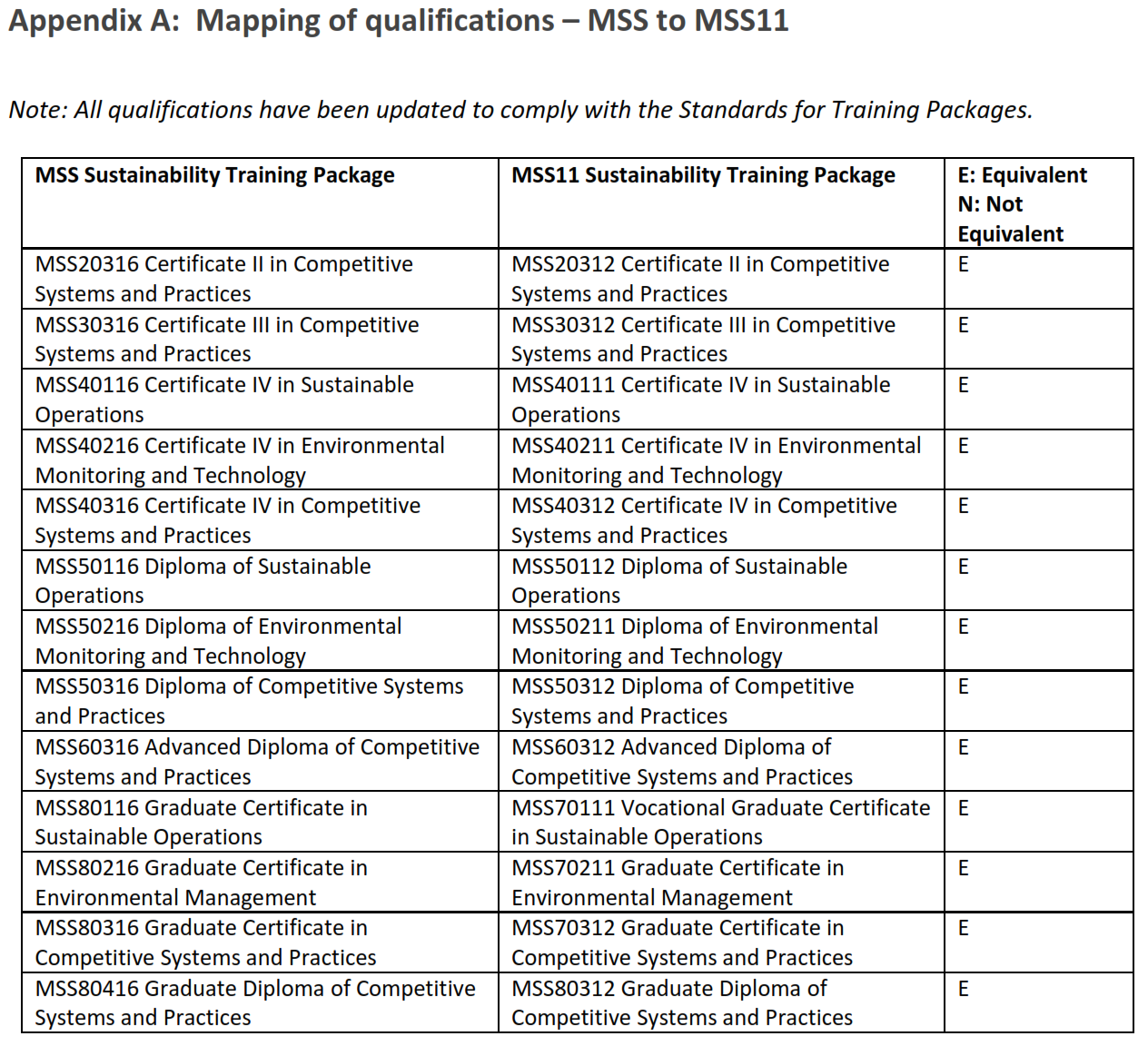
Source: MSS Sustainability Implementation Guide
The qualification template has been amended but the changes don’t have a significant effect on the content of the qualifications.
Packaging rules
The packaging rules for the MSS Sustainability qualifications have not changed. This means no changes to the core units to be achieved nor the number of electives and which elective Groups they can be taken from. Note however, that the Groups may have some changes to the electives available.
Competitive Systems and Practices
The Competitive Systems and Practices qualifications live in the MSS Sustainability Training Package. Actually this is not new as the CSP qualifications were added into the MSS11 Release 2.0 back in May 2012.
However it is important to note that the Skills for Sustainability website, including this article, does not provide any specific information or advice about the Competitive Systems and Practices qualifications or units of competency.
What’s new in the Skill Sets?
No changes have been made to the codes or titles of the MSS Energy Efficiency Skill Sets. However, the codes of the units that make up the Skill Sets have been changed, as per the previous sections.
| Code | Title |
| MSSSS00001 | SS1 Audit energy usage for a work area |
| MSSSS00002 | SS2 Determine energy usage |
| MSSSS00003 | SS3 Improve energy usage for a process or organisation |
| MSSSS00004 | SS4 Improve energy usage for a work area |
| MSSSS00005 | SS5 Recommend energy improvements |
| MSSSS00006 | SS6 Reduce sustainability risk |
Implementation Guide
The Companion Volume Implementation Guide provides information to support the implementation of the MSS Sustainability Training Package. The Implementation Guide contains:
- mapping of qualifications and units between MSS and MSS11 (Appendix A and Appendix B)
- an outline of the qualifications and how they align to the AQF levels
- advice on choosing electives
- a glossary of terms that relate to foundation skills (p37). This can be used to identify the foundation skills within a unit of competency and to interpret what type of evidence is acceptable.
- explanation of other terms used in units of competency (Appendix C) e.g embodied carbon, social sustainability metrics and typical problems; it also shows the units in which the term is used.

Leave a Reply